Skip to content
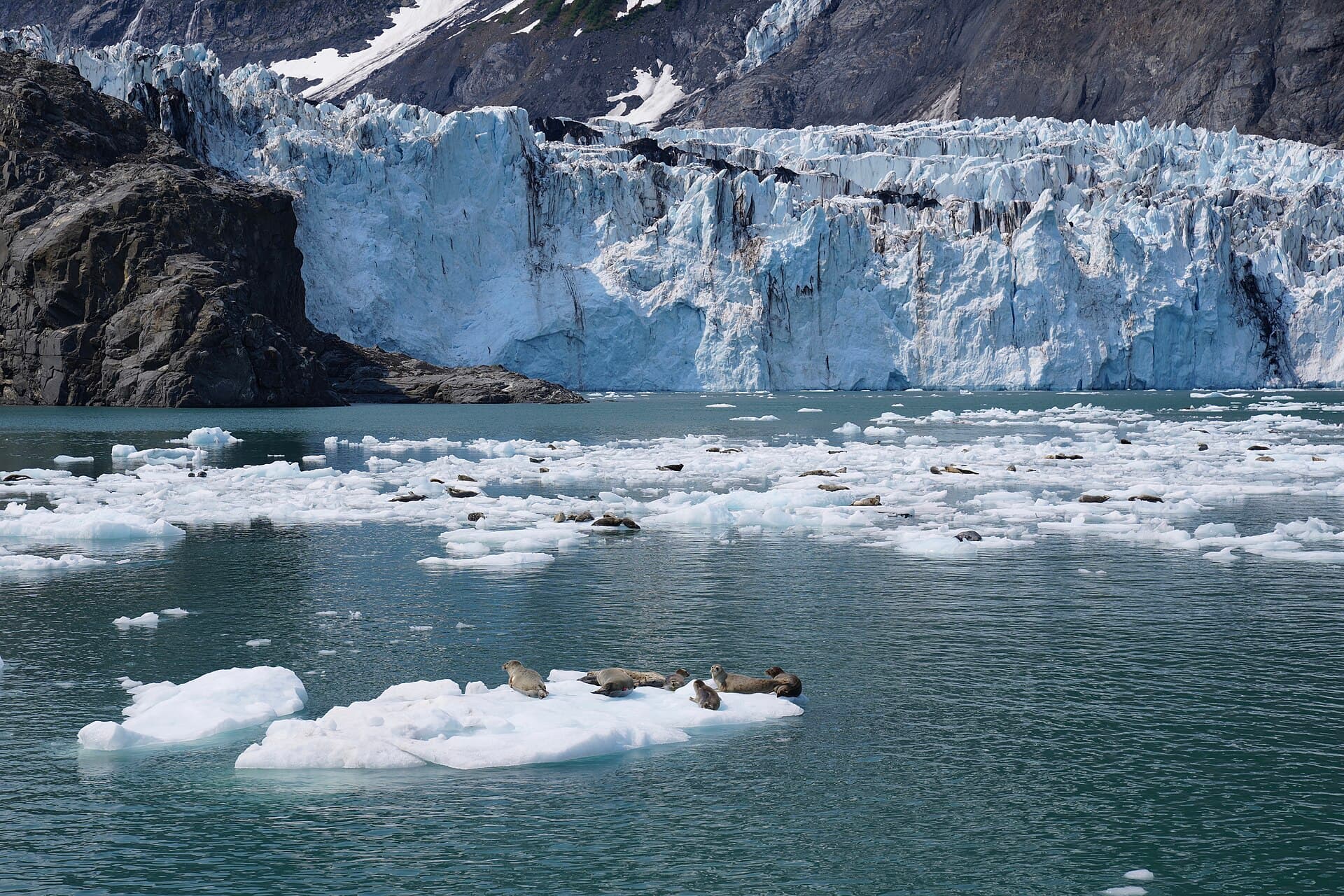
Harbor seals resting on a floating ice floe in front of a tidewater glacier in Glacier Bay

What to watch for

Field Guide

The wildlife and glaciers of the Inside Passage, and how to know what you are seeing.

Half the joy of this trip is the watching. A spout out on the gray water, a white dot high on a cliff, a wall of blue ice that suddenly thunders. This is a small guide to the animals and glaciers we are most likely to see, what gives each one away, and exactly where on our route to look. Keep it handy at the rail.

From the rail

Whales & sea life

The water is where the trip surprises you. Out past the rail, in the channels and open straits, this is what to watch for and how to know what you are seeing. Keep the binoculars close and your eyes soft on the surface.

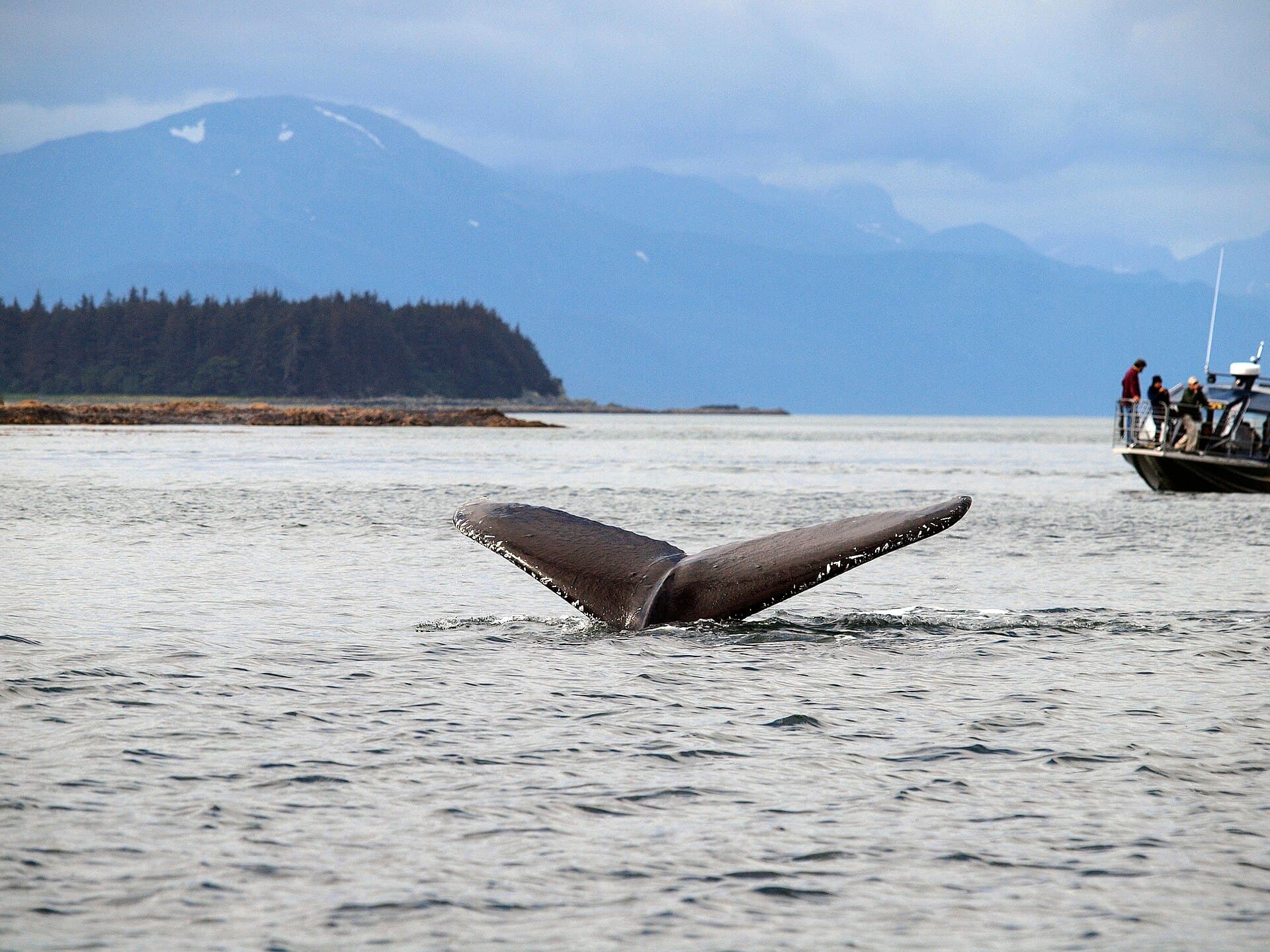
A humpback whale's tail fluke lifting from the water in Southeast Alaska

Humpback whale

The big one we all came hoping to see, and in July they are everywhere.

Look first for the blow: a tall, bushy column of mist that hangs in the air for a second before it fades. Once you see one, keep watching that same patch of water, because the whale will roll up again, showing a long, dark, knuckly back. The real reward comes on the deep dive, when it lifts that wide tail, the fluke, high out of the water and slides under. Every fluke is patterned a little differently underneath, like a fingerprint.

If we get very lucky, we may see one throw its whole body out of the water in a breach, or a group herding fish with a ring of bubbles. That second one is bubble-net feeding, and Frederick Sound is one of the best places on earth to watch it happen.

Size
40–50 ft, up to about 40 tons
Look for
tall bushy blow, then the raised tail on a dive
Best chance
Frederick Sound, Stephens Passage, the Juneau whale-watch

On our trip: We have good odds almost any time we are in open water, but our prime stretches are Frederick Sound and Stephens Passage on the way north, and the waters around Juneau, where a whale-watch boat trip is the surest bet of the whole trip. Keep an eye out in Glacier Bay too.

Most of the humpbacks we will see spent the winter near Hawaii or Mexico and swam thousands of miles north just to eat here all summer. They barely feed on the breeding grounds, so this is their big working season, the same as ours is a holiday.

Photo: Gillfoto / Kenneth John Gill (CC BY-SA 4.0)
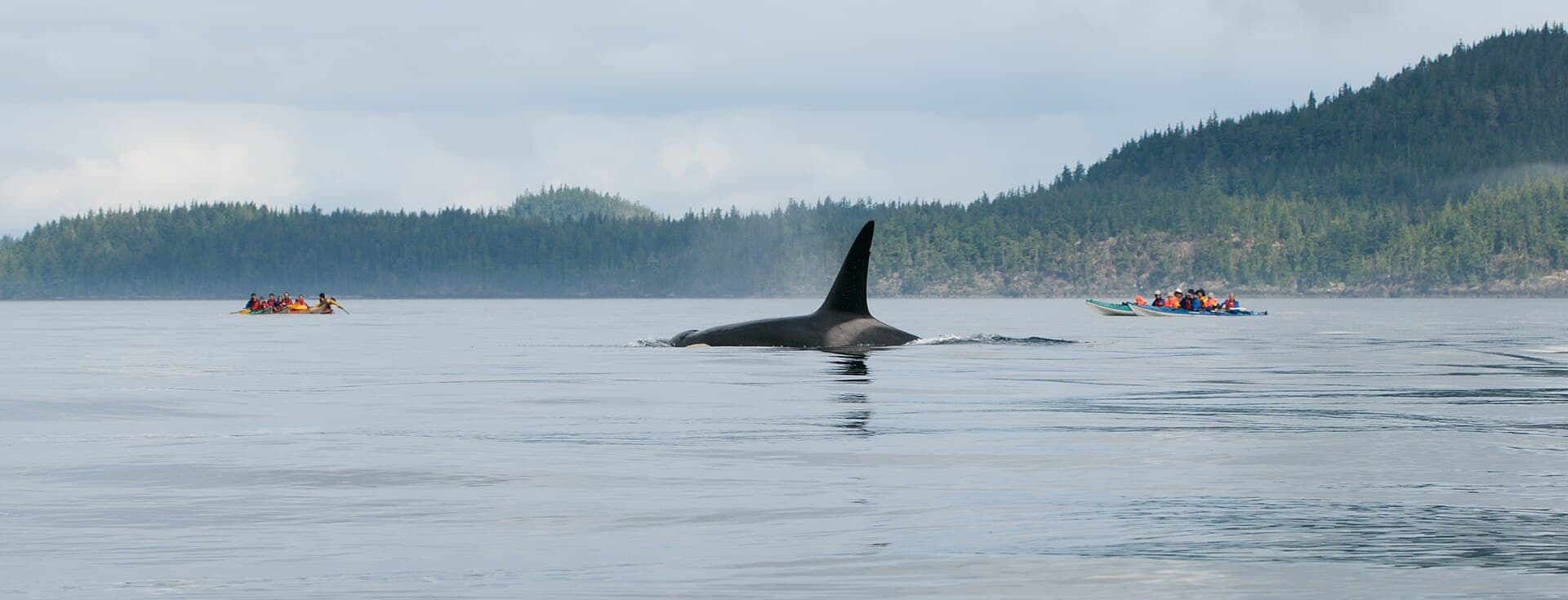
An orca surfacing in Johnstone Strait with sea kayakers nearby

Orca / killer whale

The unmistakable black-and-white shape that makes the whole rail go quiet.

Orcas give themselves away with that tall, straight dorsal fin slicing up through the surface, jet black against the gray water. The males carry a fin that can stand as tall as a grown person, while the females and youngsters have a shorter, more curved one. Watch for the crisp white patch behind the eye and the pale saddle just behind the fin as they roll.

They almost always travel as a family group, so if you spot one fin, scan left and right and you will usually find several more rising and falling together. They move with real purpose, and a pod cutting across the channel is one of the great sights of the north coast.

Size
20–27 ft; males up to about 6 tons
Look for
the tall straight dorsal fin and white eye patch
Best chance
Johnstone Strait, open straits of the Inside Passage

On our trip: Johnstone Strait, which we cross early in the cruise below Alaska, is one of the most reliable orca spots anywhere. We may also catch them anywhere along the Inside Passage and in the deeper Alaskan straits, so it is worth a glance at the water whenever we are moving.

Orcas live in tight family pods that can stay together for life, and each pod has its own calls, a kind of family dialect. Some of these northern families have been followed by researchers for more than forty years, so a few of the whales out there are older than I am.

Photo: Winky (CC BY 2.0)

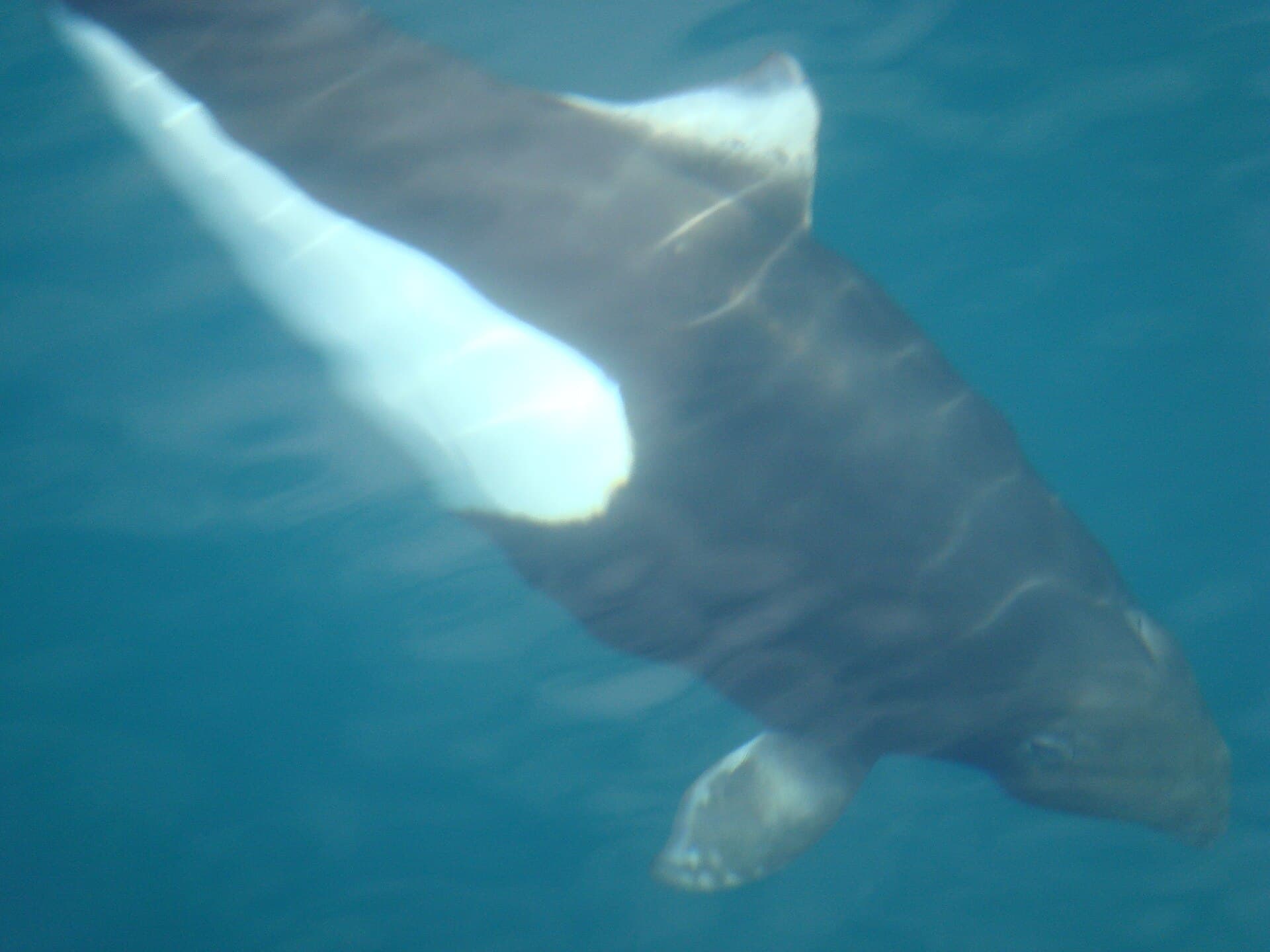
A Dall's porpoise swimming just below the surface in clear blue Alaskan water

Dall's porpoise

The little speedster that loves to surf along beside the ship.

Dall's porpoises are small, stocky, and beautifully marked in crisp black and white, a bit like a tiny orca. You rarely see the whole animal; instead you catch the fast flash of a white side and a burst of spray. When they race at full speed they throw up a fan of water off their backs called a rooster tail, a little splash that follows them along.

The fun part is that they come to us. They love to ride the pressure wave at the bow of a moving ship, darting back and forth just under the surface. If you see quick splashes racing toward the bow, get to the front of the rail.

Size
6–7 ft; up to about 480 lbs
Look for
black body, white flank, and a spray rooster tail
Best chance
at the ship's bow on deep-water transit days

On our trip: These can turn up anywhere we are moving through deep water, all along the Inside Passage and the Alaskan straits. They are most likely to show themselves when the ship is making good speed, so they may come to play at the bow on a transit day between ports.

Dall's porpoises are the fastest of all the porpoises, able to hit around 30 miles an hour. That is why they enjoy our bow wave so much: at cruising speed the ship finally gives them a wave worth surfing.

Photo: NancyHeise (public domain)

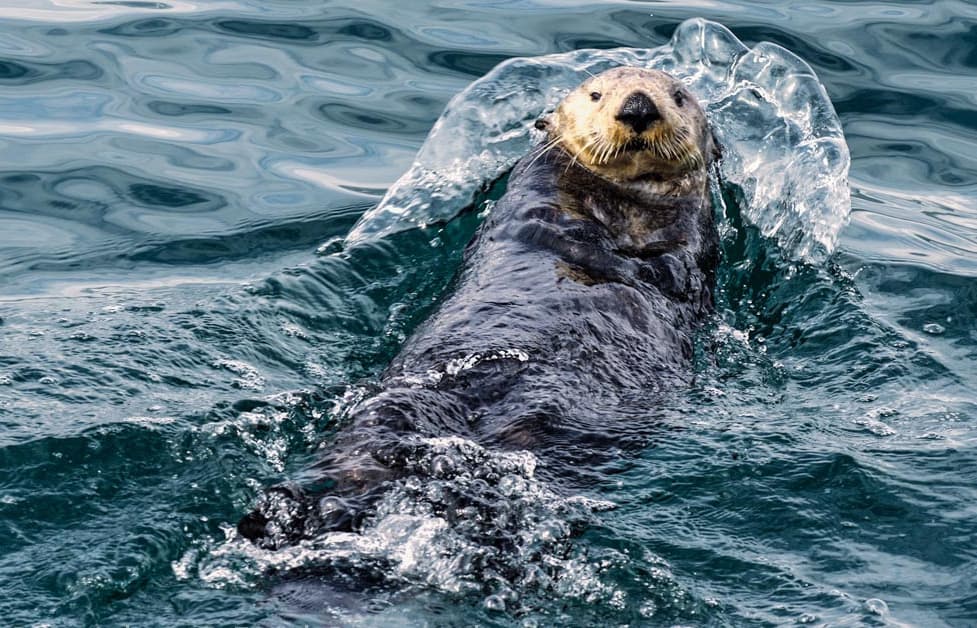
A sea otter floating on its back in Alaskan water

Sea otter

The one everyone falls for, floating on its back like it has nowhere to be.

Sea otters are easy to love and easy to spot once you know the pose: they float on their backs at the surface, often with their paws held up out of the cold water. Look for a small dark shape low in the water, sometimes rolling, sometimes just drifting. A mother may carry a pup riding on her chest, and they will often gather in loose groups called rafts.

Bring the binoculars for this one, because they sit low and can look like a floating log at first. The giveaway is the way they fuss and groom, working air into that famously thick fur.

Size
4–5 ft long; up to about 100 lbs
Look for
floating on its back, paws up, often grooming
Best chance
Glacier Bay; also Prince William Sound

On our trip: Glacier Bay is our best chance by far. The calm, protected water there holds a lot of otters, and the day we spend cruising the bay is a good one to watch the surface near the shoreline and the ice. We may also see them in Prince William Sound near the end of the cruise.

Sea otters have no blubber to keep them warm, so they rely on the densest fur of any animal on earth, up to a million hairs in a single square inch. That is why they are forever grooming: they are trapping air in that coat to stay warm in water that would chill us in minutes.

Photo: G. Frank Peterson (CC BY 2.0)

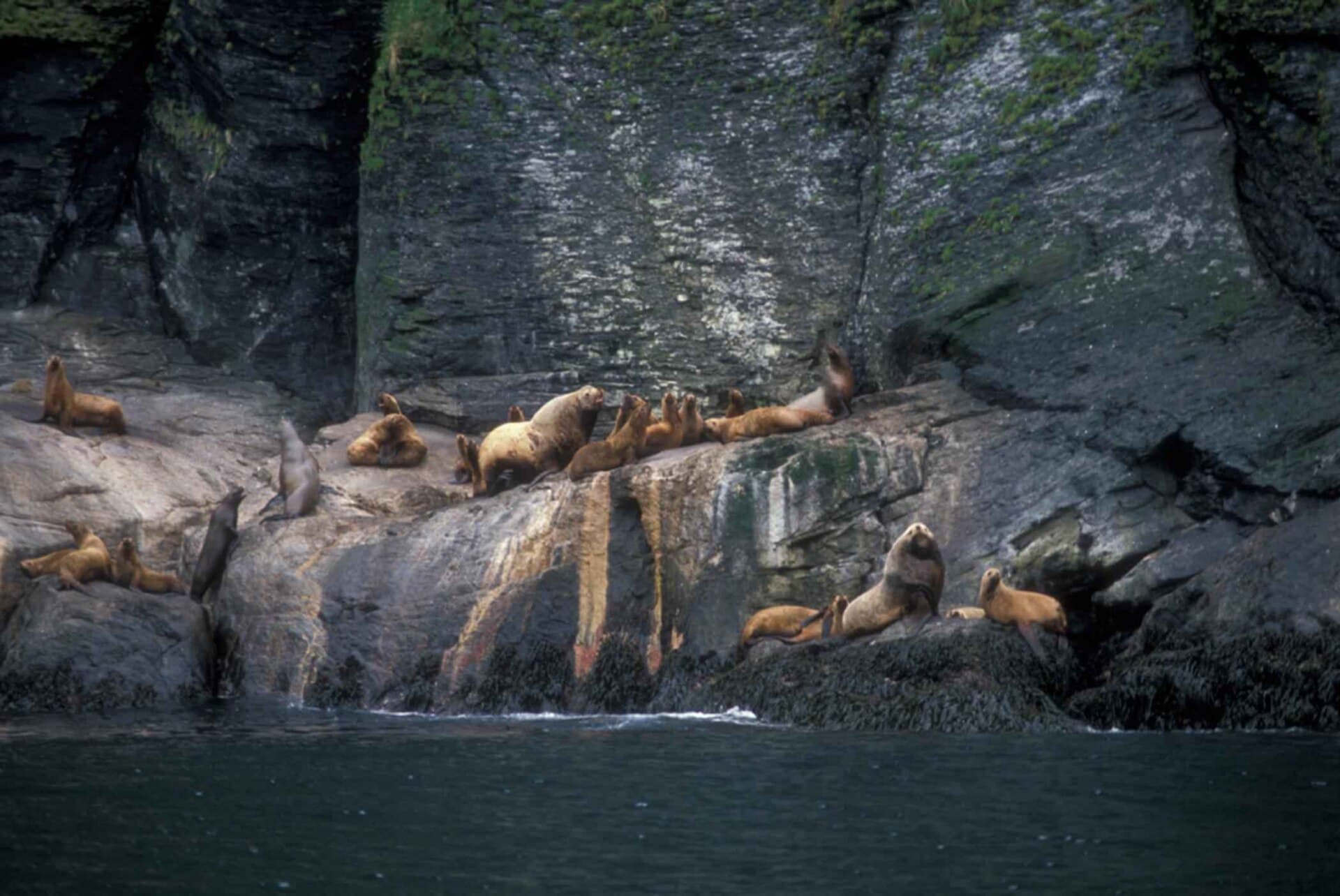
A haulout of Steller sea lions resting on coastal rocks above the water in Alaska

Steller sea lion

You will often hear this one before you see it, a whole rookery roaring off the rocks.

Steller sea lions pile up on rocky islets and ledges in big, noisy groups called haulouts. Look for a heap of tawny, golden-brown bodies sprawled on the rocks just above the waterline, often with a few big bulls sitting up tall and proud above the rest. They are far larger than the harbor seals, and they have visible little ear flaps and long front flippers they use to prop themselves up.

On the water they swim with their heads up and their chests out, and they bark, growl, and bellow constantly. A rock covered in them is a wonderful, rowdy thing to drift past.

Size
bulls up to 11 ft and over 2,000 lbs
Look for
golden-brown bodies and small ear flaps on rocks
Best chance
rocky islets along the Inside Passage and near ports

On our trip: Watch the rocky points and small islands all along the Inside Passage, and near the harbors at Ketchikan, Juneau, and Skagway. Any lone rock crowned with golden bodies and a lot of noise is almost certainly a sea lion haulout.

The big bulls can weigh as much as a small car, well over a thousand pounds, yet they haul themselves right up onto sheer rock. They are named for Georg Steller, the naturalist who first described them on Vitus Bering's expedition to Alaska back in 1741.

Photo: Bob Angell / USFWS (public domain)

Harbor seals resting on a floating ice floe in front of a tidewater glacier in Glacier Bay

Harbor seal

In Glacier Bay they raft onto the floating ice to raise their pups, and it is a tender sight.

Harbor seals are the round, calm, dog-faced ones. Look for a smooth gray or brown body, speckled with darker spots, resting on a chunk of floating ice or low on a sandbar. Unlike the sea lions, they have no visible ear flaps and they cannot prop up on their flippers, so on land they look like they are lounging on their bellies, sometimes curled into a comma shape with head and tail lifted.

In the water you will usually just see a smooth, whiskery head pop up, watch you for a moment with big dark eyes, and quietly sink away. They are shy and they do not make the racket the sea lions do.

Size
5–6 ft; up to about 250 lbs
Look for
spotted, ear-less seals resting on floating ice
Best chance
Glacier Bay icebergs (July pupping season)

On our trip: Glacier Bay is the place to look, especially the day we cruise it. The icebergs that calve off the tidewater glaciers become floating nurseries, and in July mothers haul their newborn pups out onto the ice to nurse, safe from predators. Scan the floating ice near the glacier faces.

Glacier Bay hosts one of the largest gatherings of harbor seals in Alaska, and the floating ice is the whole reason. A pup born on a drifting iceberg is hard for a bear or a wolf to reach, so the glaciers that thrill us are also a safe nursery for the seals.

Photo: Richard N Horne (CC BY-SA 4.0)

Shore & sky

On the coast and overhead

Keep one eye on the land. The beaches, the salmon streams, the cliffs, and the treetops all have their regulars, and once your eye learns the shapes you will start spotting them everywhere. A patient scan with binoculars finds far more than a quick look.

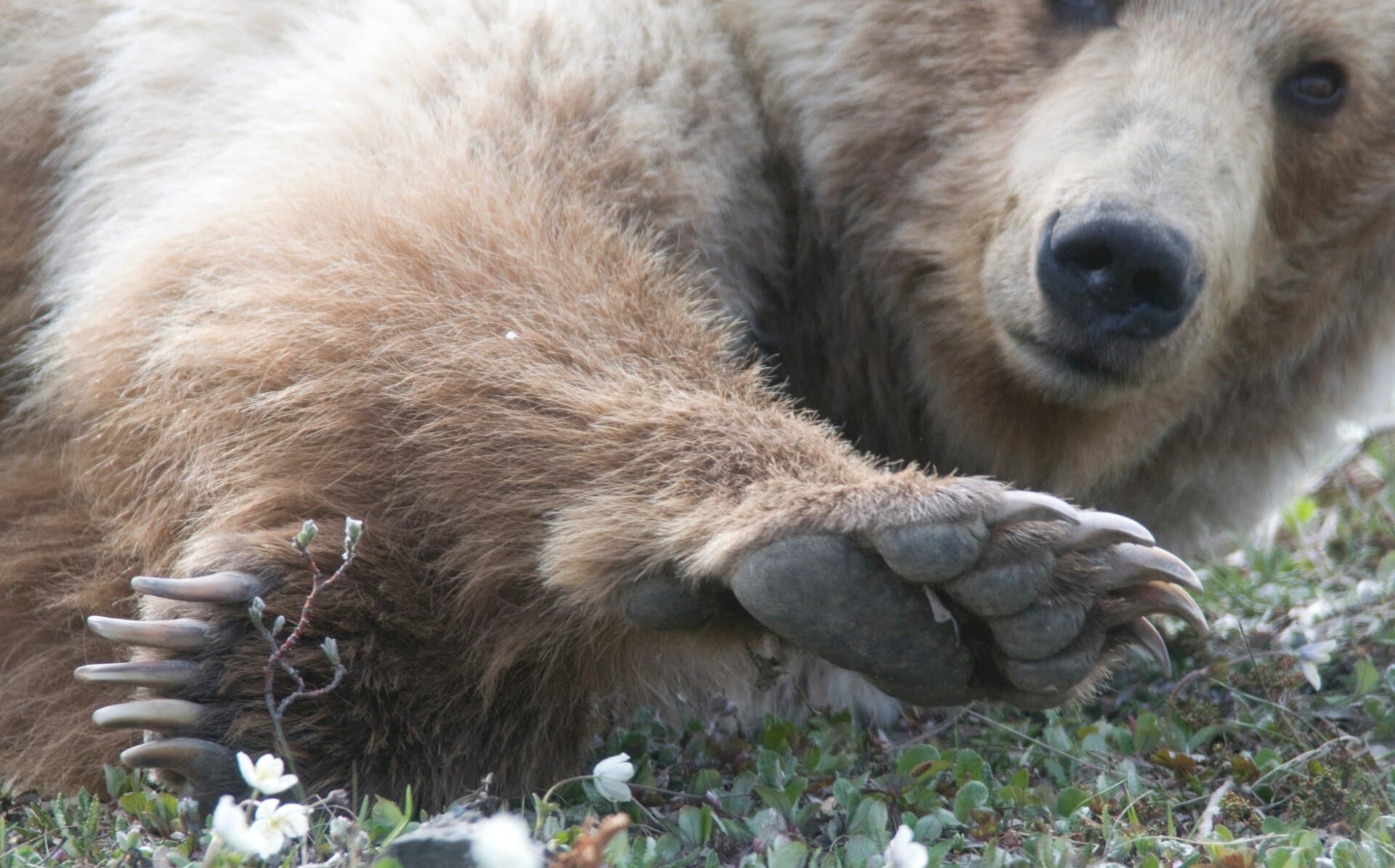
A grizzly bear in Denali National Park

Brown bear

The big one with the shoulder hump, fishing the salmon streams.

When people picture an Alaska bear, this is the one: a heavy, broad-shouldered brown bear, what most of us call a grizzly, standing in a stream with salmon all around its feet. The giveaway is the muscular hump over the shoulders and a wide, dished face. In July the salmon are running, so the bears come down to the water to feed, and that is exactly when we will be there.

We are most likely to spot one from the ship or a tour boat along a quiet shoreline, or out on the flats where a river meets the sea. Brown bears keep their distance, so a calm scan of the beaches with binoculars is the way to find them.

Size
a large male can stand over 8 ft and top 1,000 lbs in a good year
Look for
the shoulder hump and a dished, concave face
Best chance
Glacier Bay shores, river mouths, and the Denali land days

On our trip: Watch the shorelines and river mouths as we cruise Glacier Bay on Wednesday, July 23, and keep an eye out around Juneau too. The best brown bear stories of all, though, will likely come on our Denali land days, where the open country makes them easier to see.

That shoulder hump is pure muscle that powers the front legs for digging, which is how a bear this size can turn over boulders and dig out a den.

Photo: NPS / Kent Miller (public domain)

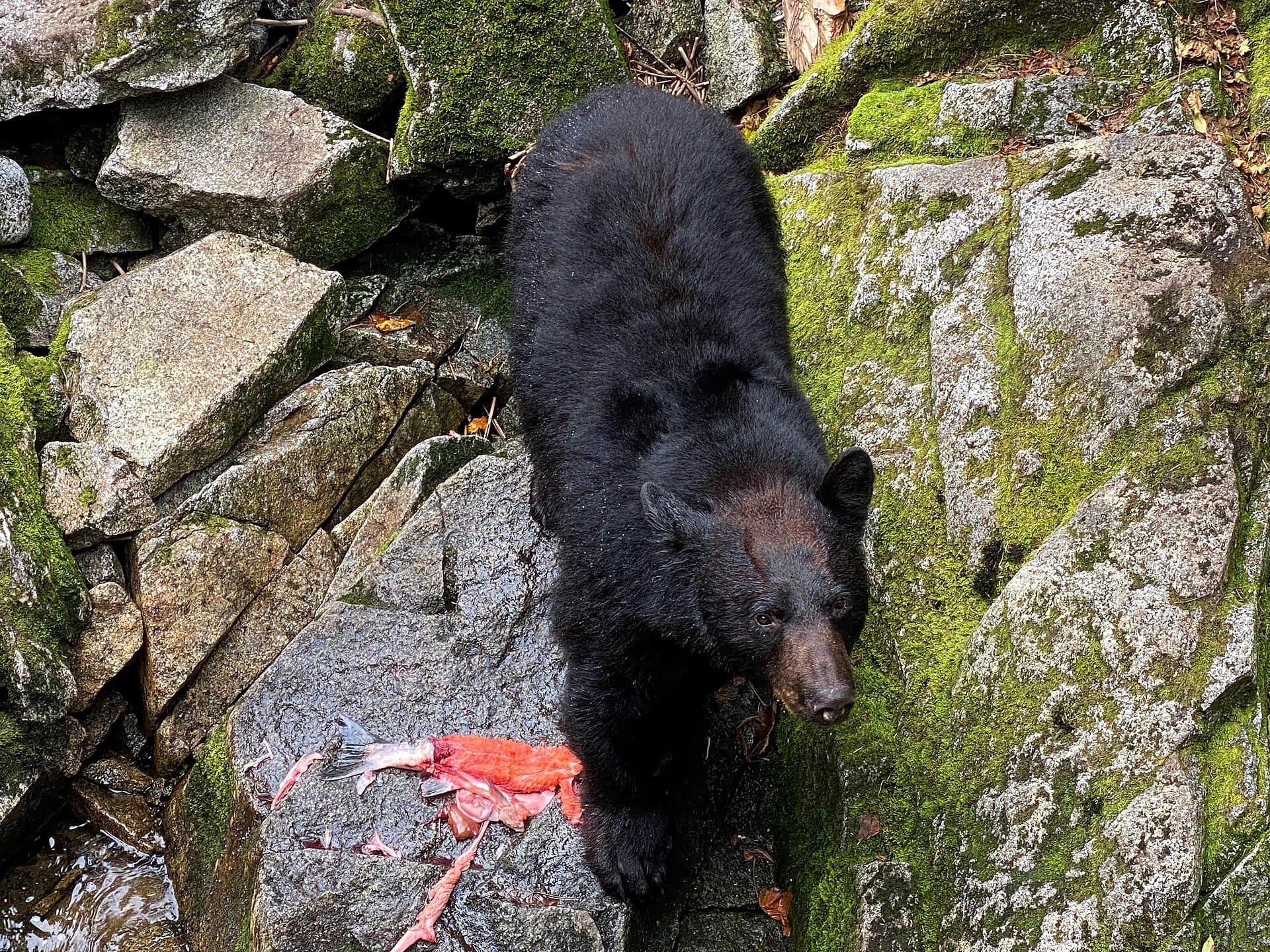
A black bear on the mossy rocks of a salmon stream in the Tongass rainforest

Black bear

The smaller, straight-faced cousin of the coastal forest.

Black bears are the more common bear of the Southeast Alaska rainforest, and they love the same salmon streams the big browns do. They are smaller and rangier, with a straight face from forehead to nose and tall, pointy ears, and no shoulder hump. Despite the name their coat can be black, brown, or even a deep cinnamon, so go by the shape, not just the color.

Look for them along wooded shorelines and at the edges of streams where salmon are pushing upriver. They are nimble and a little shy, often slipping back into the trees the moment they feel watched.

Size
smaller than a brown bear; roughly 150–350 lbs
Look for
no shoulder hump, a straight face, tall ears
Best chance
wooded shorelines and salmon streams near Ketchikan and Juneau

On our trip: The forested shores around Ketchikan and Juneau are prime black bear country, and the salmon are running hard in July. Watch the treelines and stream mouths from the ship and on any shore tours; a patient scan with binoculars is how most people find them.

Black bears are superb climbers, and a frightened one will often shoot straight up a tree; brown bears, built for digging instead, rarely climb as adults.

Photo: U.S. Forest Service, Alaska Region (public domain)

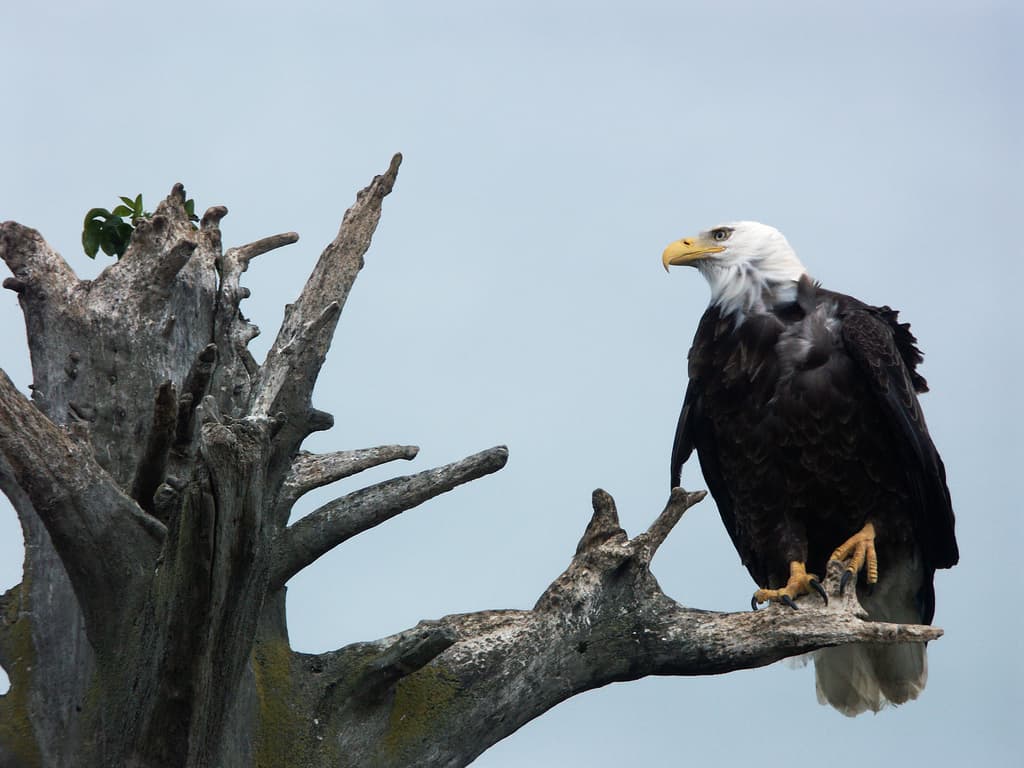
A bald eagle perched on a weathered snag in coastal Alaska

Bald eagle

White head, dark body, perched on every other piling.

Down here in the lower 48 a bald eagle is a lucky day. In Southeast Alaska they are almost ordinary, and that never stops being a thrill. Look for the snow-white head and tail against a dark chocolate body, often perched at the very top of a spruce or on a dock piling, just watching the water. In flight they soar on long, flat, plank-straight wings.

Young eagles can fool you: they are mottled brown and white and do not get the clean white head until about five years old. If you see a big brown raptor that looks messy, it may be a young bald eagle growing into its colors.

Size
wingspan of roughly 6–7.5 ft; Alaska birds run large
Look for
white head and tail; a flat, straight-winged soar
Best chance
every port and shoreline; pilings, snags, treetops

On our trip: You will see these all along the coast, in every port. Scan the pilings and treetops around Ketchikan, Juneau, and Skagway, and watch the shoreline snags as we move through Glacier Bay on July 23. Once your eye learns the shape, you will spot them everywhere.

The Chilkat River near Haines, just up the coast from us, draws the largest gathering of bald eagles on earth, with up to 4,000 birds arriving for a late salmon run.

Photo: Paul Resh (CC BY 2.0)

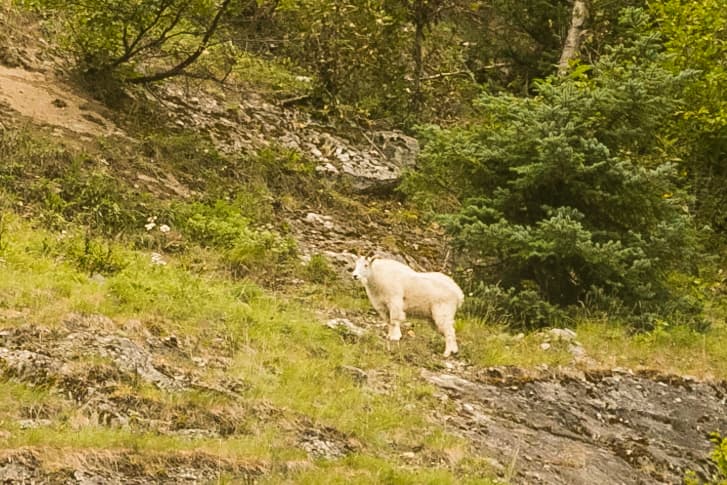
A white mountain goat on a green hillside above the water near Skagway

Mountain goat

The white dots high on Glacier Bay's cliffs.

As we cruise into Glacier Bay, look up. Those small white specks on the steep grey cliffs are not patches of snow; they are mountain goats, picking their way across ledges that seem impossible to stand on. Through binoculars you will see a shaggy white coat, a black nose, and short black horns on both males and females. They have a stocky, hunched look, like they are wearing a heavy winter coat in July.

Gloomy Knob, a rounded rock outcrop in Glacier Bay, is a classic spot to find them; the naturalist on board often points it out. The goats favor the cliffs because almost nothing can reach them up there.

Size
roughly 100–300 lbs; waist to chest height at the shoulder
Look for
an all-white shaggy coat and slim black horns, way up on cliffs
Best chance
Glacier Bay cliffs on July 23, around Gloomy Knob

On our trip: Glacier Bay on Wednesday, July 23, is our best shot, especially the cliffs around Gloomy Knob. Keep watching the steep rock above the shoreline; once someone spots the first white dot, the rest of us usually find them fast.

Mountain goats are not true goats at all; their closest relatives are antelope, and their split, rubber-rimmed hooves grip rock like climbing shoes.

Photo: Diego Delso (CC BY-SA 4.0)

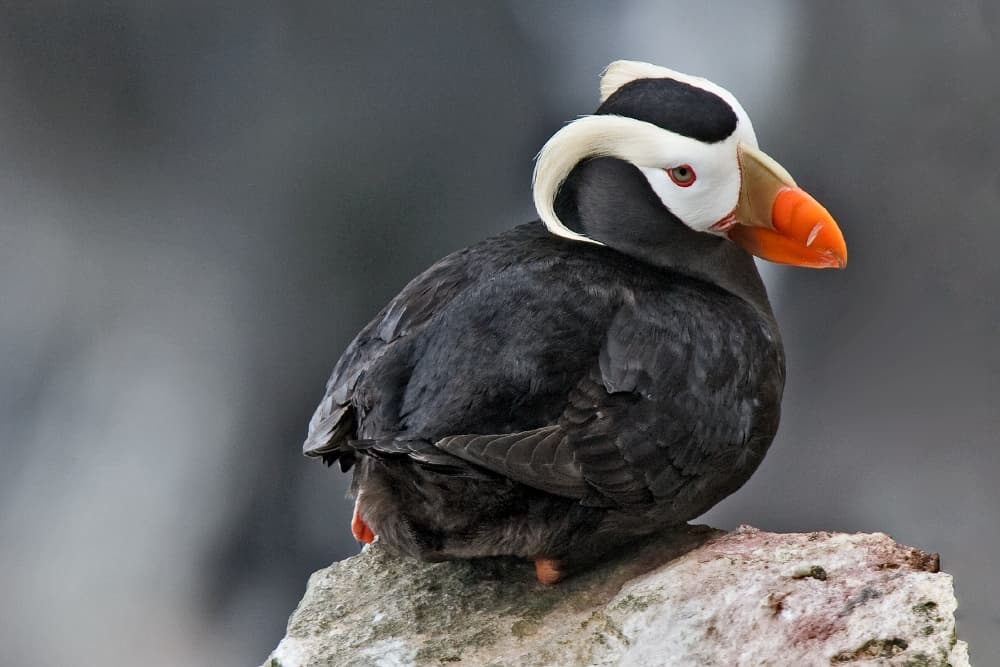
A tufted puffin in breeding plumage with its orange bill and golden head plumes

Tufted puffin

The clown of the sea, nesting on the rocky islets.

Puffins are everyone's favorite, and for good reason. The tufted puffin has a chunky dark body, a big bright orange bill, and a white face trailing two long golden plumes that sweep back over its head like a fancy hairstyle. They sit low on the water and fly with a fast, buzzy wingbeat that looks almost too quick for such a round little bird.

Watch for them on and around rocky islets where they nest in burrows on the grassy tops. They often raft together on the water near these colonies, bobbing in little groups.

Size
about 15 in long, a bit bigger and chunkier than a football
Look for
bright orange bill, white face, long golden head plumes
Best chance
rocky islets in Glacier Bay, the South Marble Islands

On our trip: Glacier Bay on July 23 is the place to look, particularly the South Marble Islands, a noisy seabird colony the tour often slows down for. Scan the water near the rocks and the air just above it, and you may catch their stubby silhouettes whirring past.

A puffin can hold a dozen or more small fish crosswise in its bill at once, thanks to backward-pointing spines on its tongue and palate that pin the catch in place.

Photo: Alan D. Wilson (CC BY-SA 3.0)

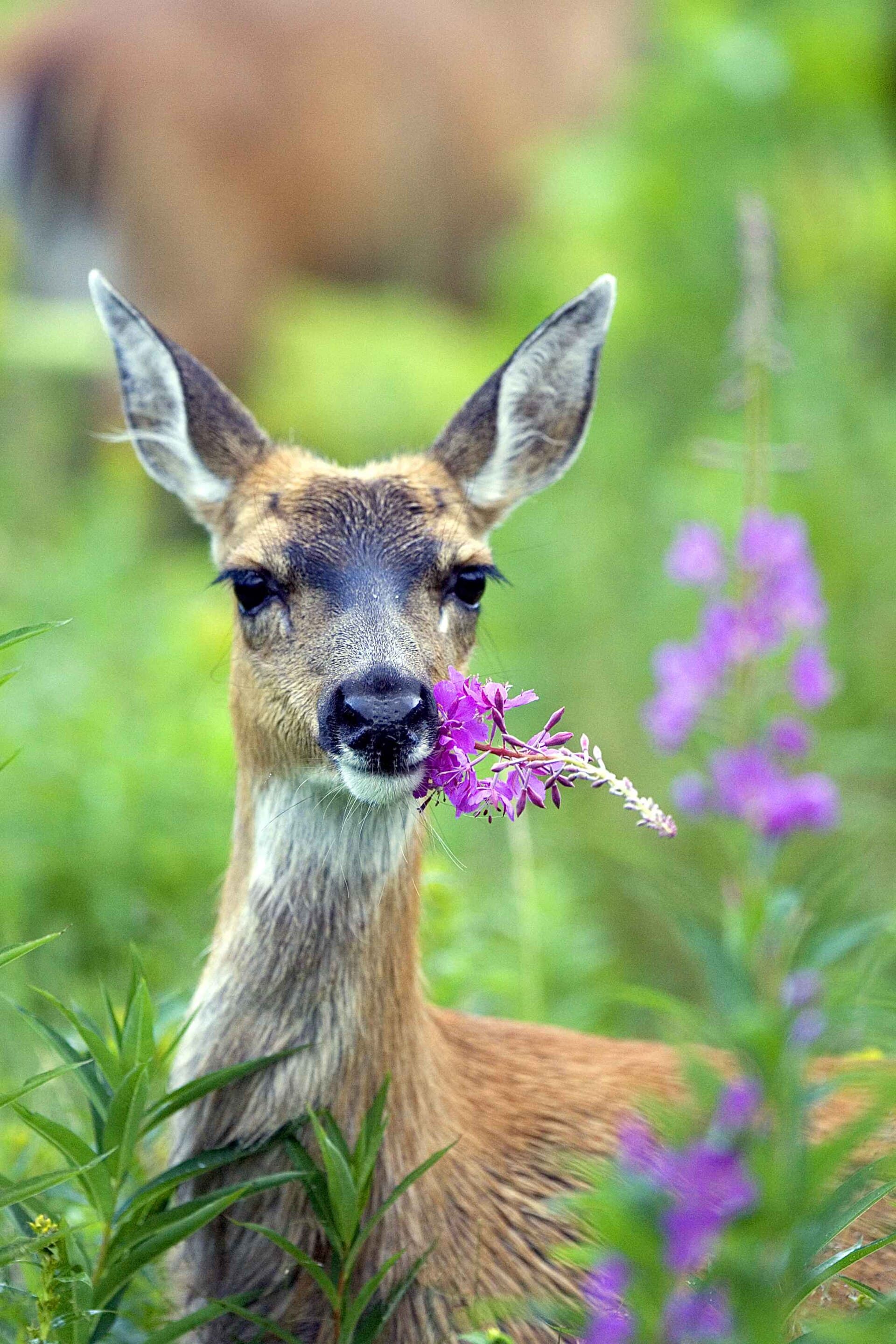
A Sitka black-tailed deer nosing purple fireweed in summer

Sitka black-tailed deer

The small, gentle deer of the coastal rainforest.

These are the little deer of the Southeast Alaska rainforest, smaller and stockier than the deer we know back home, with a warm reddish-brown summer coat, big rounded ears, and the short black tail that gives them their name. They are quiet browsers, slipping along forest edges and clearings, often half-hidden in the tall summer greenery.

Look for them at the edge where forest meets open ground, especially early and late in the day. In July they are often nose-deep in wildflowers like fireweed, which makes for a sweet sight if you catch one.

Size
small for a deer; adults run roughly 80–120 lbs
Look for
reddish summer coat, large rounded ears, short black tail
Best chance
forest edges near Ketchikan, Juneau, and Glacier Bay

On our trip: Watch the forested shorelines and clearings around Ketchikan and Juneau, and the green slopes above Glacier Bay on July 23. They blend in well, so look for movement and the flick of those big ears at the treeline.

These deer are strong swimmers and will paddle between islands across open saltwater, which is part of how they have spread all through the islands of Southeast Alaska.

Photo: Steve Hillebrand / USFWS (public domain)

Reading the ice

Glaciers & ice

On our two glacier days the ice itself becomes the wildlife. Here is how to read it: where a glacier comes from, why it is blue, why it thunders, and what all those shapes and stripes are telling you.

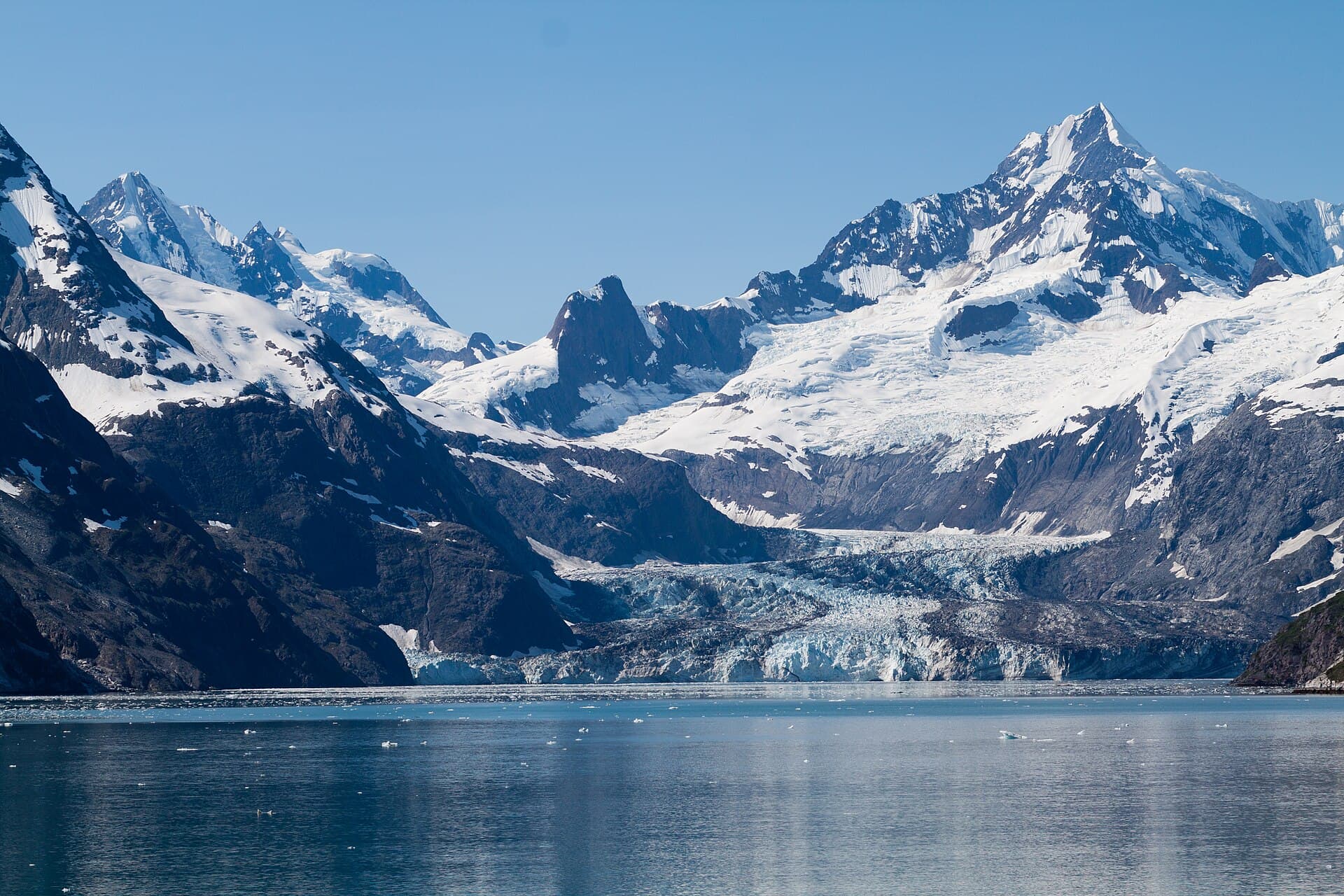
Johns Hopkins Glacier beneath a wall of snowy peaks

How a glacier is born

It starts as a single snowflake, and ends as a river of ice that flows.

It is easy to think of a glacier as just a big frozen lake, but it is really a slow river, and like a river it has a beginning. High up in the mountains, more snow falls each winter than can melt away each summer. That leftover snow piles up year after year, and as new snow buries the old, the buried layers get squeezed. The fluffy flakes are pressed into a grainy, half packed snow called firn, and then, under the growing weight above, the firn is crushed into dense, clear glacial ice.

Here is the part that surprises everyone. Once that ice gets thick enough, its own weight makes it flow. Slowly, stubbornly, the whole frozen mass begins to creep downhill, a river of ice moving so gradually you cannot see it happen but fast enough to grind valleys and carry mountains of rock. Every glacier we will see began as single snowflakes that fell, perhaps, before any of us were born, and have been pressed and pushed downhill ever since.

Where
Johns Hopkins (Glacier Bay), fed from the high snowfields
Look for
snowy peaks up top feeding the flowing ice below
Did you know
snow becomes firn, then ice that flows under its own weight

On our trip: Johns Hopkins in Glacier Bay is a beautiful place to picture this whole journey at once: trace its ice from the snowy peaks where it is still being born, down the long flowing valley, all the way to the cliff where it finally calves into the sea in front of us.

The ice calving off a glacier face can be astonishingly old. The snow that fell to start it may have landed a century or more ago, so when a chunk drops into the bay, you are quite possibly watching snow that fell in your grandparents' lifetime finally reach the sea.

Photo: Alan Wu (CC BY-SA 2.0)

The face of Margerie Glacier in Glacier Bay

Tidewater glaciers

A river of ice that flows all the way down to the sea, and breaks off right in front of you.

These are the glaciers that put on the show. A tidewater glacier is a river of ice that has flowed down out of the mountains and reached the ocean, so instead of melting away on land it ends in a sheer cliff of ice standing right in the water. That cliff is the part we come to see. It can rise hundreds of feet straight up out of the sea, taller than it looks until a tour boat or a kayak drifts past for scale and suddenly you understand how big it really is.

Watch the face for a while and you will notice it is alive. Meltwater pours off it, chunks of ice drop from it, and the whole wall groans and cracks as the glacier behind keeps pushing forward. We will sit in front of these for a good while, so let your eyes wander up to where the ice meets the mountains and trace the whole frozen river back to where it began.

Where
Margerie & Johns Hopkins (Jul 23); Harvard & Yale (Jul 24)
Look for
a sheer cliff of ice standing right in the water
Did you know
Margerie's face rises roughly 250 ft above the water, more below

On our trip: Almost every glacier on this trip is a tidewater glacier, which is exactly why we chose this route. In Glacier Bay on Wednesday, July 23, we will see Margerie and Johns Hopkins ending in the sea, along with Lamplugh and Grand Pacific. The next day, July 24, College Fjord gives us Harvard and Yale, two more tidewater giants right at the head of the fjord.

The reason the captain stops the ship a respectful distance back is that a tidewater glacier can drop a piece of ice the size of a building without warning, sending out a wave big enough to rock a vessel. The best seats are the quiet ones, far enough back to watch it all in safety.

Photo: Larry D. Moore (CC BY 4.0)

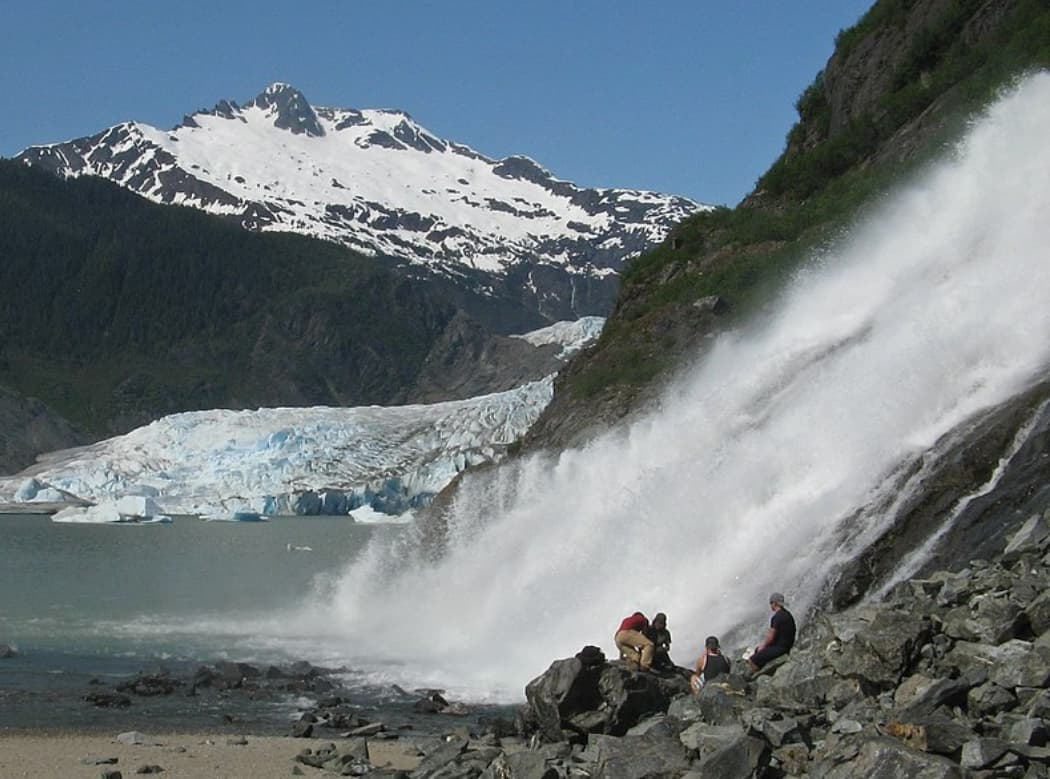
Mendenhall Glacier with Nugget Falls beside it

Valley glaciers

A glacier you can walk right up to, with a waterfall thundering in beside it.

Not every glacier reaches the sea. A valley glacier is a river of ice that flows down a mountain valley and ends on land, which means this is the kind you can stand in front of, hike toward, and really get close to. Where a tidewater glacier shows you a wall of ice rising out of the water, a valley glacier lays the whole frozen river out in front of you, curving down between the mountains with the bare rock it has scraped clean on either side.

Because they end on land, valley glaciers often leave behind a glacial lake at their foot, milky and pale from the rock flour the ice has ground to powder. Standing at the edge of that water, looking up the long blue tongue of ice to where it disappears into the high country, is a quieter kind of wonder than the booming glacier faces, and just as moving.

Where
Mendenhall Glacier, near Juneau
Look for
the long tongue of ice ending on land, a milky lake at its foot
Did you know
Nugget Falls thunders into Mendenhall Lake right beside the ice

On our trip: Our valley glacier is Mendenhall, just outside Juneau. Unlike the glaciers we view from the ship, this is one we can actually walk up to, with Nugget Falls tumbling down right beside the ice and a lake of pale meltwater between us and the glacier face.

Mendenhall flows about 13 miles from the great Juneau Icefield up in the mountains down to its lake, and like most Alaska glaciers it has been slowly pulling back, so the easy walk to a viewpoint today is part of a view that is quietly changing year by year.

Photo: hakkun (CC BY-SA 3.0)

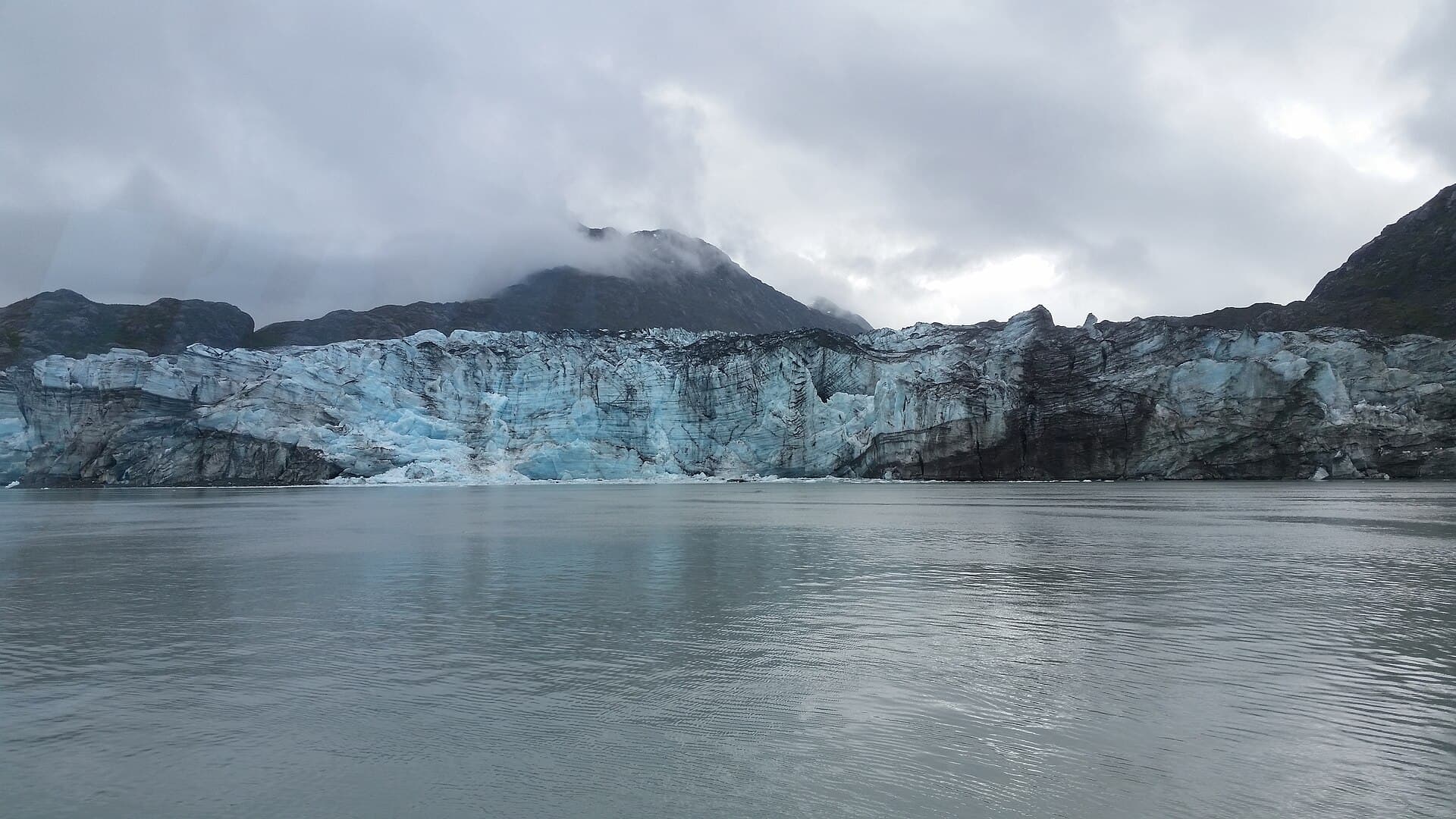
The blue face of Lamplugh Glacier

Why glacier ice is blue

The bluest ice you will ever see, and the color is the ice telling you how old it is.

The first time you see it, the blue almost looks fake, like someone tinted it. They did not. Glacier ice glows blue for a beautiful reason: when sunlight sinks into the dense ice, the ice quietly drinks up the red and orange part of the light and lets the blue pass through and scatter back out to your eye. The deeper and more solid the ice, the longer the light travels inside it, the more red gets absorbed, and the richer that blue becomes.

Ordinary ice and fresh snow look white because they are full of tiny trapped air bubbles that bounce every color back at once. Glacier ice is different. It has been buried and squeezed for so long that the air has been pressed out and the crystals have grown large and clear, so the blue can finally show. The most electric blue often hides in fresh cracks and in the ice that has just calved off, where you are seeing deep old ice for the very first time.

Where
Lamplugh & Margerie; the bergs floating near every glacier
Look for
the deepest blue in fresh cracks and freshly calved ice
Did you know
the blue is the ice absorbing red light; denser ice glows bluest

On our trip: Watch for it on the faces of Lamplugh and Margerie in Glacier Bay, and again at Harvard and Yale in College Fjord. Lamplugh in particular is famous for its blue, and the icebergs floating near these glaciers often show the deepest color of all.

On an overcast Alaska day the blue can actually look stronger, not weaker. Without bright white sunlight washing over the surface, the deep blue coming out of the ice has the stage to itself, so do not be disappointed by a gray sky.

Photo: Pi3.124 (CC BY-SA 4.0)

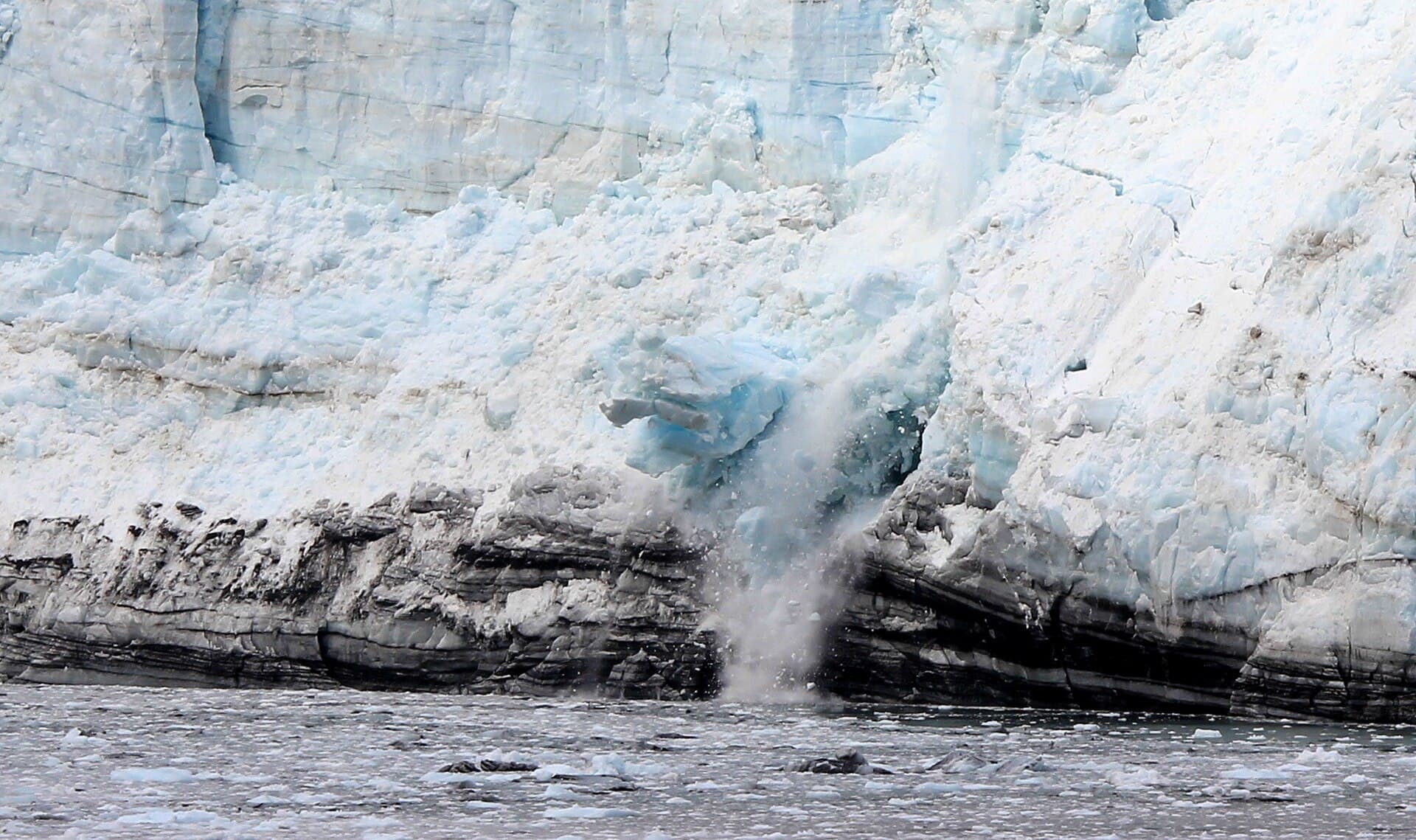
Ice breaking from a tidewater glacier in Glacier Bay

Calving

White thunder: when a piece of the glacier lets go and falls into the sea.

This is the moment everyone hopes for. Calving is when a slab of ice breaks off the front of the glacier and crashes into the water, and when it happens the whole face seems to come alive. The Tlingit people called the sound white thunder, and that is exactly right: a deep boom and crack that rolls across the water and that you feel as much as hear.

Here is the trick to actually catching it, and it surprises everyone. Sound travels much slower than light, so by the time the boom reaches you across the water, the ice has already fallen. If you wait for the crack you heard, you will be looking at the wrong spot and you will miss it. So do not watch the noise. Keep your eyes soft and wide on the whole ice face, watch the water at the base for sudden splashes and ripples, and let the booms be a signal to keep looking, not a place to look.

Where
Margerie & Johns Hopkins; Harvard & Yale
Look for
the water at the base of the ice, not where you heard the crack
Did you know
the boom lags the fall; sound crosses water far slower than light

On our trip: Our two best chances are the long, slow hours in front of Margerie and Johns Hopkins in Glacier Bay on July 23, and at Harvard and Yale in College Fjord on July 24. The ship lingers on purpose so we have time for the ice to perform.

A single calved chunk can be as big as a ten story building, and when it hits, it can push up a wave that travels a long way across the fjord. That is the real reason ships and kayaks keep their distance, and the reason the best view is a patient one.

Photo: NOAA / John Bortniak (public domain)

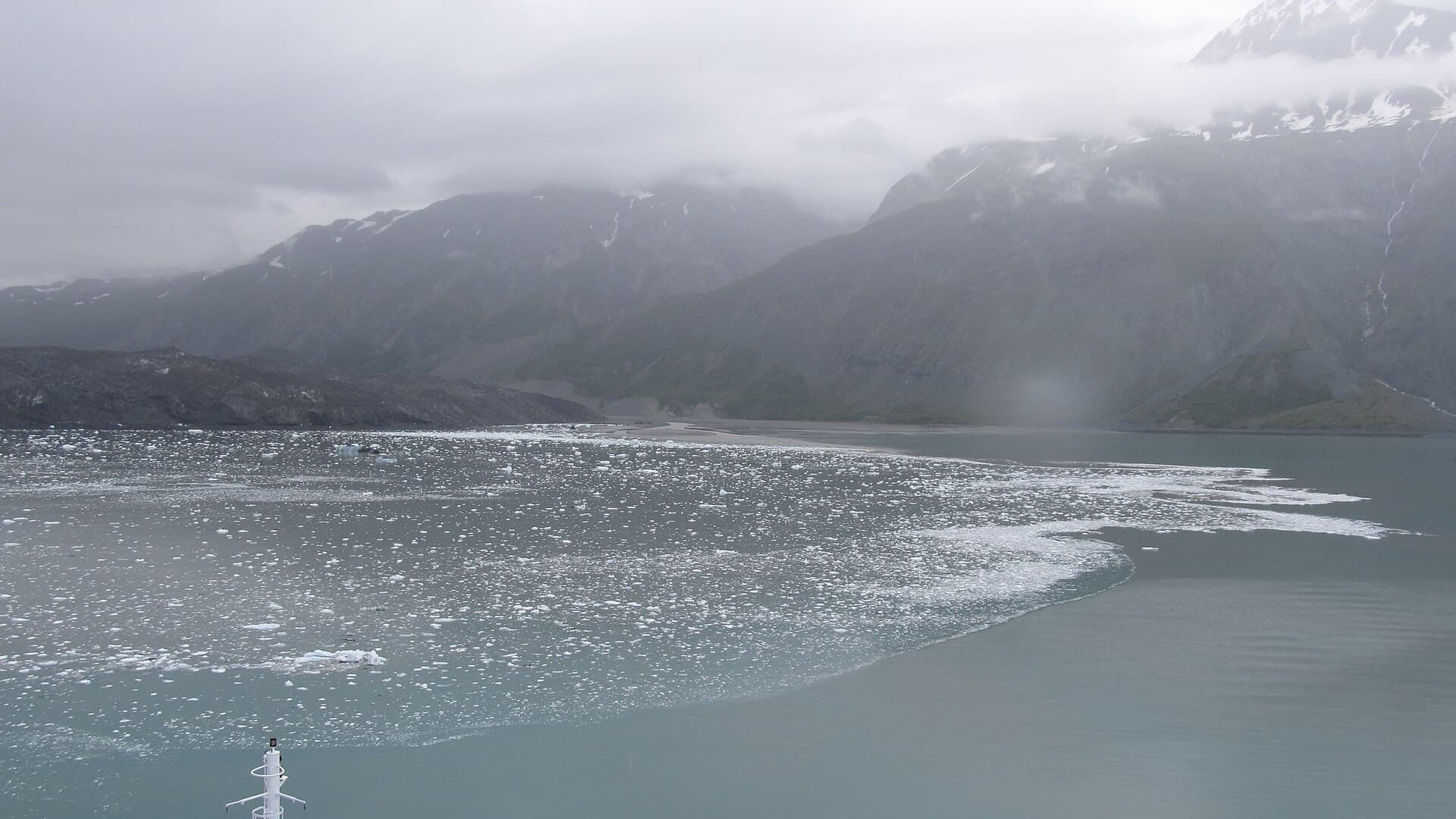
Ice-strewn water below the dark mountains at the head of Glacier Bay

Icebergs, bergy bits & growlers

Every floating chunk of ice has a name, and nine tenths of it is hiding underwater.

Once a glacier calves, the ice it dropped goes drifting off across the fjord, and sailors long ago gave the pieces names by size. The big ones, taller than about 16 feet out of the water, are icebergs. The medium pieces, roughly the size of a small house, are bergy bits. The little ones, only a few feet across and about the size of a truck or a piano, are called growlers, named for the low gurgling, hissing sound they make as trapped air escapes and the water laps around them.

Whatever the size, the same rule holds: what you see is only the tip. Ice is just a little lighter than seawater, so about 90 percent of every berg sits hidden below the surface and only a tenth shows above. That floating chunk that looks small from the deck is far bigger than it lets on, which is exactly why even the little growlers are taken seriously by anyone steering a boat.

Where
drifting through Glacier Bay & College Fjord
Look for
harbor seals hauled out resting on the flatter bergs
Did you know
about 90 percent of every iceberg floats hidden below the water

On our trip: We will pass scattered ice all through Glacier Bay and College Fjord, thickest near the glacier faces that made it. Scan the bigger, flatter bergs near Grand Pacific and Margerie with your binoculars, because seals love to haul out and rest on them.

Harbor seals use these floating chunks as nurseries, hauling out onto the ice near the glaciers to rest and to raise their pups, where the cold water and the distance from shore help keep predators away. A berg dotted with napping seals is one of the gentlest sights in the bay.

Photo: Explorer1940 (CC BY-SA 4.0)

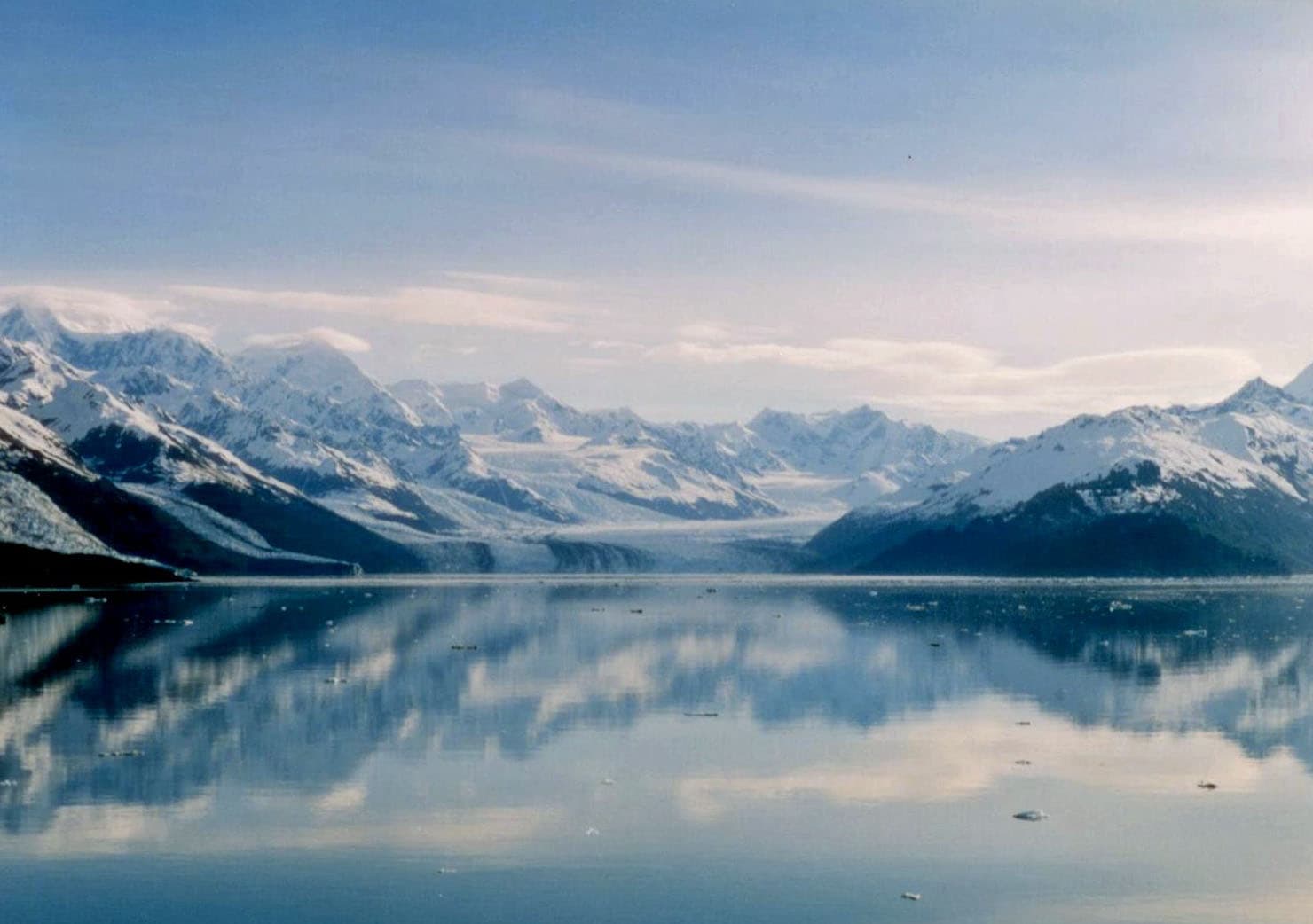
College Fjord mirror-calm with glaciers reflected

Moraines, the dark stripes

Those dark streaks on the ice are the mountains themselves, carried along for the ride.

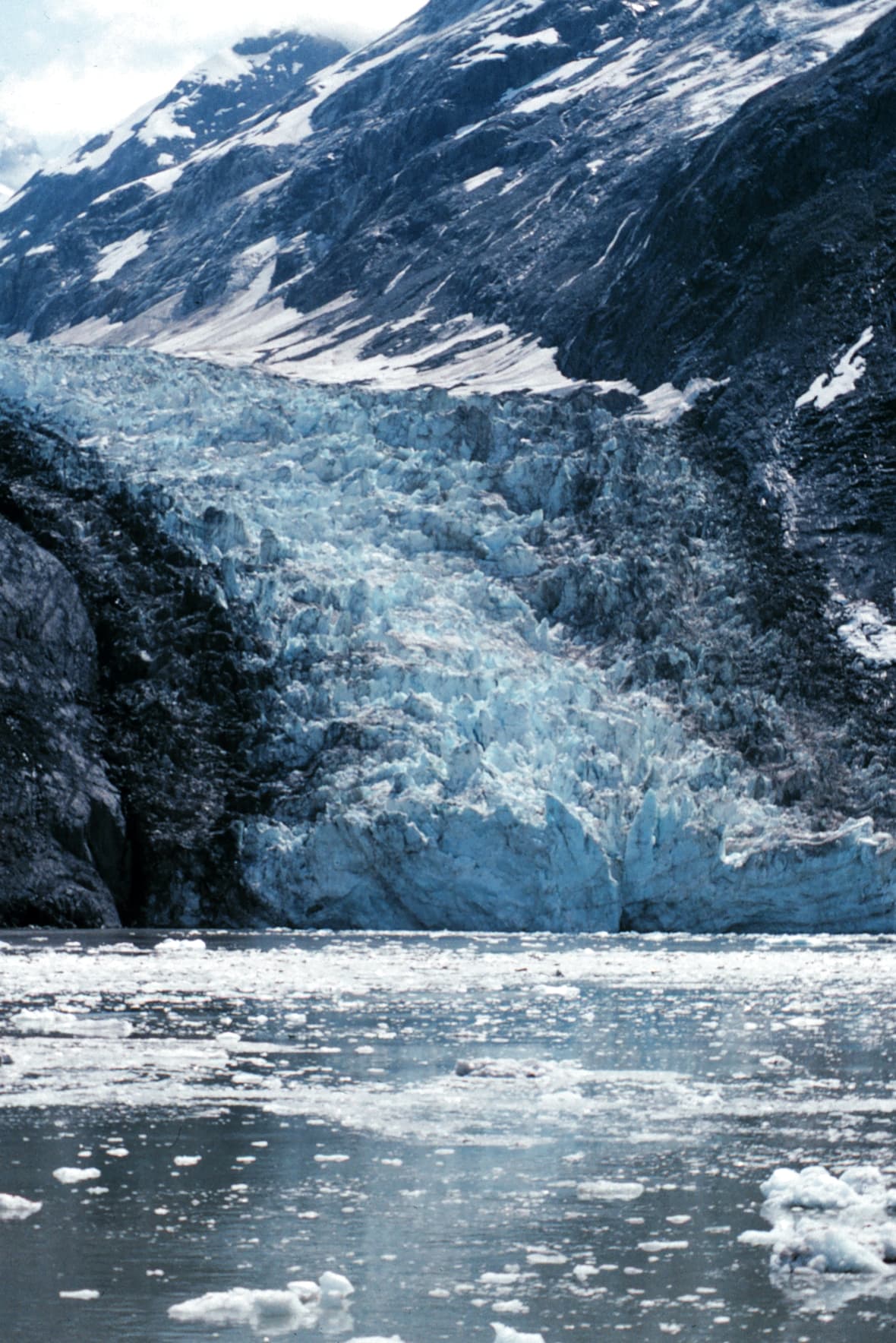
Look closely at a glacier and you will often see dark stripes running down its length, like racing lines on the white ice. Those are moraines, and they are made of real rock and rubble. As a glacier grinds down its valley it tears stone loose from the walls and the ground, and it carries all of that debris along, sometimes for miles, the way a slow conveyor belt carries whatever lands on it.

The stripes along the two edges of the glacier are called lateral moraines, the rock it has scraped off the valley walls on either side. The really striking ones are the dark lines running right down the middle. Those form when two glaciers flow together and meet, like two lanes of traffic merging, and the rocky edges they each carried get pinched into a single stripe down the center. So when you trace a dark line up the ice, you are usually looking at the seam where two rivers of ice became one.

Where
the larger glaciers in Glacier Bay and College Fjord
Look for
dark stripes; edge stripes are lateral, center stripes are medial
Did you know
a center stripe marks where two glaciers flowed together and merged

On our trip: Watch for these dark stripes on the big glaciers in Glacier Bay and College Fjord, especially where you can see several streams of ice flowing together high up in the mountains before they join into one broad glacier reaching down toward the water.

When a glacier finally retreats, it leaves all that carried rock dumped in a long ridge across the land, and that ridge is a moraine too. The new forests and meadows growing in Glacier Bay today are taking root in rubble the ice set down not long ago, so the moraine is both a stripe on the ice and a seed bed for what comes next.

Photo: RCraig09 (CC BY-SA 4.0)

A keepsake guide for the Glacier Gang. Wildlife and glacier notes gathered from NOAA Fisheries, the National Park Service, and the U.S. Forest Service. Every photo is properly licensed and credited on its card.